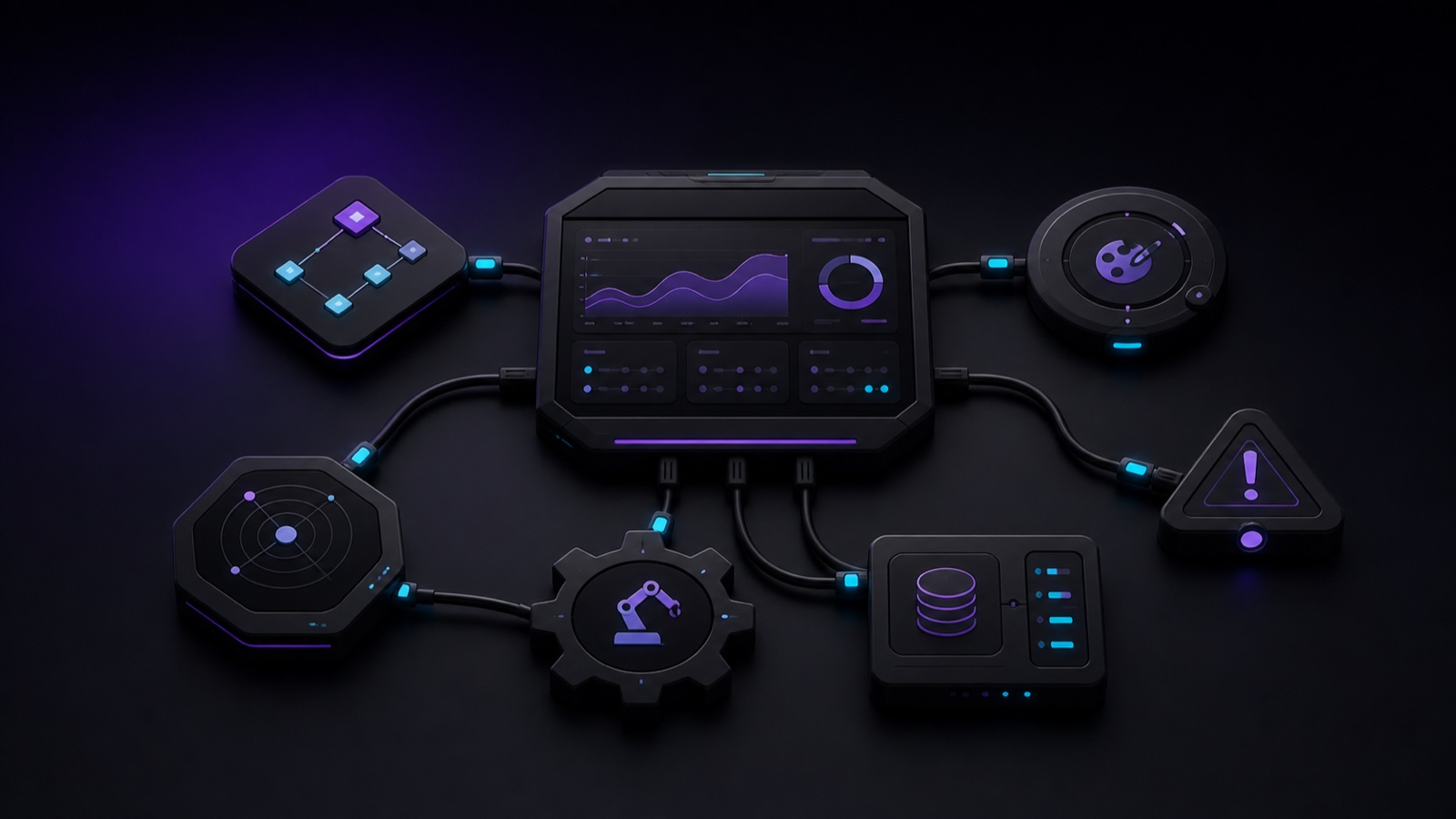
The best media buying tools stack is not the one with the longest logo slide. It is the smallest system that lets a team answer five questions without rebuilding the data by hand:
- Where did this click come from?
- Which landing, PWA or offer did it reach?
- Which business event actually happened?
- What did the traffic cost and what revenue settled?
- Who can change the campaign, account or payout rule?
If those answers live in five exports with different IDs, adding a sixth dashboard will not fix the operation. This guide groups tools by responsibility, shows which categories can be combined, and provides a 30-day evaluation plan for affiliates, agencies and in-house performance teams.
If the model itself is new to you (offers, networks, payout types and how profit is counted), start with what traffic arbitrage is and how it works.
The media buying stack at a glance
| Layer | Job | Minimum evidence it works |
|---|---|---|
| Traffic sources | Buy and deliver impressions/clicks | Platform spend and stable campaign/ad identifiers |
| Research and creative | Produce angles, ads and landing variants | Versioned creative IDs and approval history |
| Tracker and routing | Create click identity, route traffic, receive postbacks | One click traced end to end |
| PWA / landing delivery | Serve the experience and keep session context | Install/open/CTA events attached to the source click |
| Conversion feedback | Return status, value and transaction identity | Deduplicated callback and accepted platform event |
| Analytics and finance | Reconcile spend, revenue, payouts and P&L | Totals tie back to source records |
| Automation | Alert, pause, reroute or scale under explicit rules | Dry-run log, limits and rollback |
| Team access | Assign accounts and protect sensitive data | Role test with least-privilege access |
The important design choice is not “all-in-one or best-of-breed?” It is where the source of truth sits for each object and how identifiers cross each boundary.
1. Traffic-source tools
Meta Ads, TikTok Ads, Google Ads, native networks and DSPs are distribution systems. They know their campaigns, ad groups, creatives, spend and platform-side conversions. They do not automatically know whether an affiliate deposit was approved, reversed or paid out.
Capture stable IDs in URL parameters and API imports. Keep names for humans, but never use a mutable campaign name as the only join key. For concrete templates, see Facebook Ads URL parameters and macros and TikTok Ads macros and sub IDs.
Evaluation questions:
- Can cost be imported at the level where budget decisions are made?
- Are campaign, ad-set/ad-group and ad/creative IDs all available?
- What happens when an account is disabled or reassigned?
- Can the team prove which buyer owned the account on a given date?
2. Creative research and production tools
Ad libraries, spy tools, editors, asset storage and AI production tools solve discovery and production. They should not become an undocumented attribution database.
Every exported creative needs a durable internal code. Store source, angle, format, language, version and owner separately. When the ad platform creates its own creative ID, map it to that internal code rather than replacing it. This keeps analysis intact when the same concept is resized, translated or relaunched in a new account.
A useful naming record looks like this:
creative_key: dc-casino-proof-vertical-v03-ru
angle: social-proof
format: 9x16-video
language: ru
owner: buyer-17
platform_creative_id: 120219...
The exact string matters less than consistency. The failure mode is putting all five dimensions into an ad name and trying to parse them months later.
3. Trackers and routing software
A tracker should create or preserve a unique click ID, apply routing rules, send traffic to the correct destination and attach later conversions to that click. Compare tools on the route you actually operate—not a generic feature grid.
Typical shortlist models include:
- self-hosted trackers, where the team owns the server and maintenance;
- managed cloud trackers, where the vendor operates the infrastructure;
- connected operations platforms, where tracking is tied to PWA, account and finance workflows;
- lighter link trackers, appropriate when routing and postback needs are limited.
Use self-hosted vs cloud tracker to choose the operating model. If the shortlist is vendor-specific, compare Keitaro and Voluum, Binom and Voluum, or the broader ad tracking software guide.
The acceptance test is simple to state and often skipped: click one test link, record the generated ID, inspect the final offer URL, send one conversion, then find the same ID with the correct source, route, status, payout and transaction.
4. Landing, PWA and domain tools
The page layer is not just a design asset. It is part of the measurement path. Redirects can drop parameters, JavaScript can rebuild URLs incorrectly, and a PWA lifecycle can detach an install or later open from the source session.
For PWA traffic, verify at least:
- landing view and CTA click;
- install prompt or installation state;
- first open and later opens;
- push permission and delivery where used;
- outbound offer click with the original tracker context;
- domain and fallback behaviour when the preferred route fails.
DarkCore’s PWA Tracker, Domains and Streams are designed to keep those objects in one campaign lifecycle. This is a useful fit when PWA delivery is central; a team running only a simple direct offer may need much less.
5. Postbacks, pixels and server-side event tools
Browser pixels provide fast page-side signals. S2S postbacks report backend conversions to a tracker. Meta Conversions API and TikTok Events API send eligible server events back to the ad platforms. These channels overlap, but they are not substitutes.
Use a canonical event record with separate click, transaction and event IDs. If browser and server both send the same event, use the platform’s deduplication rules. The server-side tracking guide includes an event schema and pass/fail matrix; pixel vs CAPI vs postback explains the responsibility of each channel.
Do not accept “events appear in the dashboard” as enough. Verify status, value, currency, event time, attribution key and duplicate handling.
6. Analytics, finance and reconciliation tools
Tracker revenue is not automatically settled revenue. Platform spend is not automatically the finance ledger. A media buying team needs a controlled reconciliation between source cost, attributed conversions, advertiser status, payouts, refunds, buyer commissions and currency handling.
The minimum useful views are:
- campaign and buyer P&L by a defined period;
- spend imported from the original account or an auditable source;
- conversion status history, not only the last state;
- payout and cost corrections without silently rewriting history;
- differences between tracker, ad platform and finance totals.
Our tracker vs CRM guide explains why neither layer can honestly replace the other. DarkCore Finance is relevant when the same team needs spend, deposits, payouts and operational ownership tied to campaign records.
7. Automation and alerts
Automation should execute a known decision, not guess what the business means. Start with alerts and dry runs. Only then allow pausing, budget changes or route switches.
Every rule needs:
- an input metric with source and freshness;
- a time window and minimum sample;
- a threshold and maximum action size;
- cooldown and daily action limit;
- an owner, audit log and rollback path;
- a guardrail for missing or delayed conversion data.
For example, “pause when ROI is negative” is not a complete rule. “After at least 100 qualified clicks and 6 hours of matured conversions, alert below -20% ROI; pause only after a second check, no more than once per campaign per day” is testable.
DarkCore Auto-rules are a fit when rules need both traffic signals and real conversion/deposit outcomes. Whatever tool you choose, replay the rule against historical data before granting write access.
8. Access, account ownership and audit tools
Shared logins are not a workflow. Buyers need scoped access to their accounts and campaigns; finance data, tokens and payout settings need tighter permissions. Record ownership changes with effective dates so past P&L does not move when an account is reassigned.
Test permissions with a real low-privilege role:
- Can this buyer see only assigned accounts?
- Can they change routing or only view results?
- Are API secrets masked?
- Can a finance operator approve a correction without editing campaign setup?
- Does the audit trail show who changed a rule and when?
The Team Access layer in DarkCore is intended for this split responsibility.
Minimal stack by team stage
Solo buyer validating one funnel
- traffic-source account;
- landing or direct offer;
- tracker with click ID and postback support;
- basic creative storage;
- one reconciled sheet or ledger with documented imports.
Avoid enterprise complexity, but still test the unique click ID and duplicate callback. Small spend does not make double-counting harmless.
Growing affiliate team
- multiple traffic sources and accounts;
- tracker with routing, cost and postbacks;
- reusable landing/PWA delivery;
- creative registry;
- conversion-status and finance reconciliation;
- assigned buyer access;
- alerts before automated write actions.
This is where disconnected tools begin creating a full-time reconciliation job.
Agency or scaled buying operation
- workspace/client isolation;
- API-based spend and campaign sync;
- high-volume event ingestion with queues and retries;
- governed creative workflow;
- mature conversion and payout ledger;
- explicit automation limits and audit;
- backup, export and rollback procedures.
At this stage, evaluate the total operating cost: subscriptions plus servers, integrations, data engineering and the hours used to repair joins.
The data contract that makes the tools work together
Choose canonical identifiers before choosing another dashboard:
| Object | Canonical key | Never use as the only key |
|---|---|---|
| Click | click_id | timestamp or IP address |
| Campaign | internal campaign ID + platform campaign ID | campaign name |
| Creative | internal creative key + platform creative ID | filename |
| Conversion | transaction ID + event type | click ID alone |
| Account ownership | account ID + effective date + user ID | current owner name |
| Cost import | account/campaign ID + date/hour + currency | pasted total |
Write the mapping at every boundary. If Tool A sends subid and Tool B receives click_id, document the transformation. If one system reports cents and another reports decimal currency, normalize it once and test the round trip.
A 30-day tool evaluation plan
Days 1–3: inventory and baseline
Map the current path, exports, manual joins and weekly hours spent reconciling. Save baseline discrepancies and incident examples.
Days 4–10: one representative campaign
Choose a campaign with real routing, postbacks and at least one difficult status—not the cleanest demo. Reproduce it in the candidate stack without moving all traffic.
Days 11–17: pass/fail verification
Test routing, fallback, one conversion, duplicate callback, status change, cost correction, platform feedback, permissions, export and rollback. Record facts in a table.
Days 18–24: equal-maturity comparison
Compare cohorts only after conversions have had the same time to mature. Separate traffic-mix changes from tool effects. A higher raw conversion rate after the switch is not proof if GEO, source or offer mix also changed.
Days 25–30: operating review
Calculate total cost and the number of manual joins removed. Confirm who owns support, data quality and incidents. Expand only after the representative campaign passes.
Where DarkCore belongs in the shortlist
DarkCore should be evaluated first when the central problem is connected operations: the team needs routing, PWA delivery, conversion feedback, Facebook account operations, analytics and finance to share one campaign context. It is not honest to declare it the universal winner for every buyer. A tracker-only use case may be served well by a focused tracker; a creative-production bottleneck needs a creative tool.
The strongest DarkCore evaluation is therefore not a slogan. Map one live flow, preserve the existing IDs and postbacks, run it in parallel, and measure whether the team gets a cleaner operational truth with fewer manual joins.
FAQ
What is the most important media buying tool?
The source of truth for the decision you make most often. For traffic routing, that is usually the tracker. For profitability, it is the reconciled finance layer. The stack fails when the team treats either one as proof of the other.
Can one platform replace every tool?
Usually not. Creative production, traffic delivery and business finance are different disciplines. Consolidate where shared identifiers and workflows create value; keep specialist tools where they are materially better, but define the boundary.
How many tools should a small team use?
As few as possible while preserving click identity, conversion truth, cost and ownership. Four well-connected components are better than ten dashboards connected by exports.
Should we choose self-hosted or cloud tracking?
Choose self-hosted when the control is worth the server, backup, monitoring and incident ownership. Choose managed cloud when the team prefers predictable operations and accepts the vendor’s pricing and limits. Test your real route either way.
What should we migrate first?
One representative campaign with a reversible cutover. Do not migrate all accounts until the click ID, postback, status, cost, permissions and rollback tests pass.